
For many people with depression or OCD, medication helps, but not completely, or not at all. Trying one antidepressant after another, waiting six to eight weeks each time to know if it’s working, is its own kind of exhausting, and it can leave someone wondering whether anything will actually move the needle after enough disappointing rounds. Transcranial Magnetic Stimulation, or TMS, was developed specifically for this gap: an FDA-cleared, non-invasive treatment for people whose symptoms haven’t responded fully to standard approaches.
What TMS Actually Is
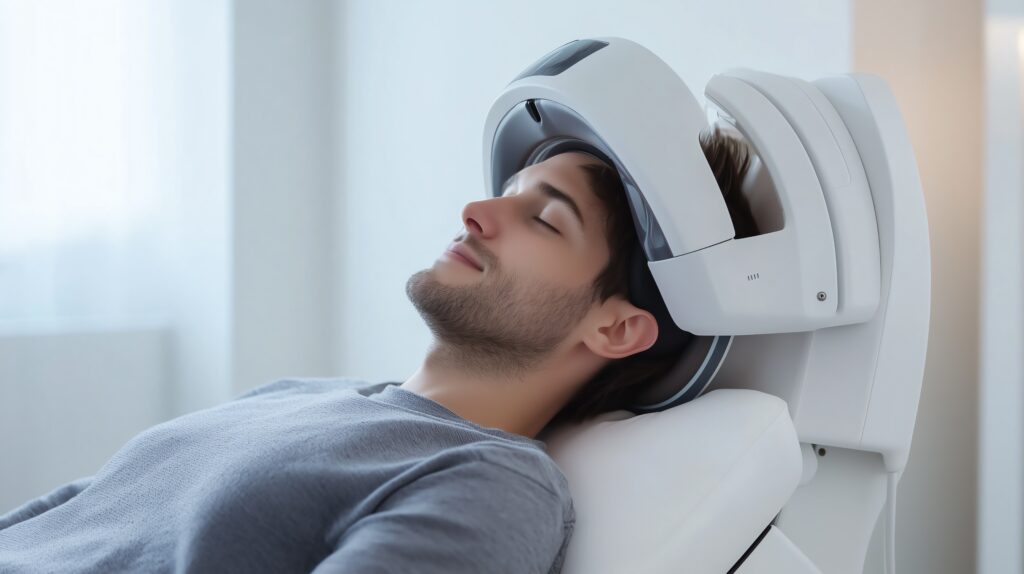
TMS uses an electromagnetic coil placed against the scalp to deliver focused magnetic pulses to specific areas of the brain, typically the prefrontal cortex, a region heavily involved in mood regulation. Cleveland Clinic describes the mechanism directly: the magnetic field is roughly the same strength as an MRI scanner, and it induces small electrical currents in nerve cells that can stimulate underactive brain regions or calm overactive ones, depending on the treatment protocol. Unlike electroconvulsive therapy, TMS requires no anesthesia, no sedation, and no recovery time — most people drive themselves to and from appointments and return to normal activities immediately afterward. South Orange County Wellness’s TMS program is integrated into its clinical treatment programs rather than offered as a standalone walk-in service, with sessions administered by qualified medical staff.
What It’s Actually Cleared to Treat
The National Institute of Mental Health confirms TMS received its first FDA clearance for treatment-resistant depression in 2008, and OCD followed a decade later. The FDA’s own 2018 clearance announcement for OCD is specific about the evidence behind it: in a randomized, multi-center trial of 100 patients, 38% of those receiving active Brainsway TMS treatment responded, defined as at least a 30% reduction in OCD severity scores, compared to just 11% in the sham-treatment group. That’s a meaningful difference for a condition that can otherwise resist treatment for years. TMS has also since been cleared for anxious depression, and researchers continue to study its use for PTSD, generalized anxiety, and bipolar depression, though those applications remain more preliminary.
What a Course of Treatment Actually Looks Like
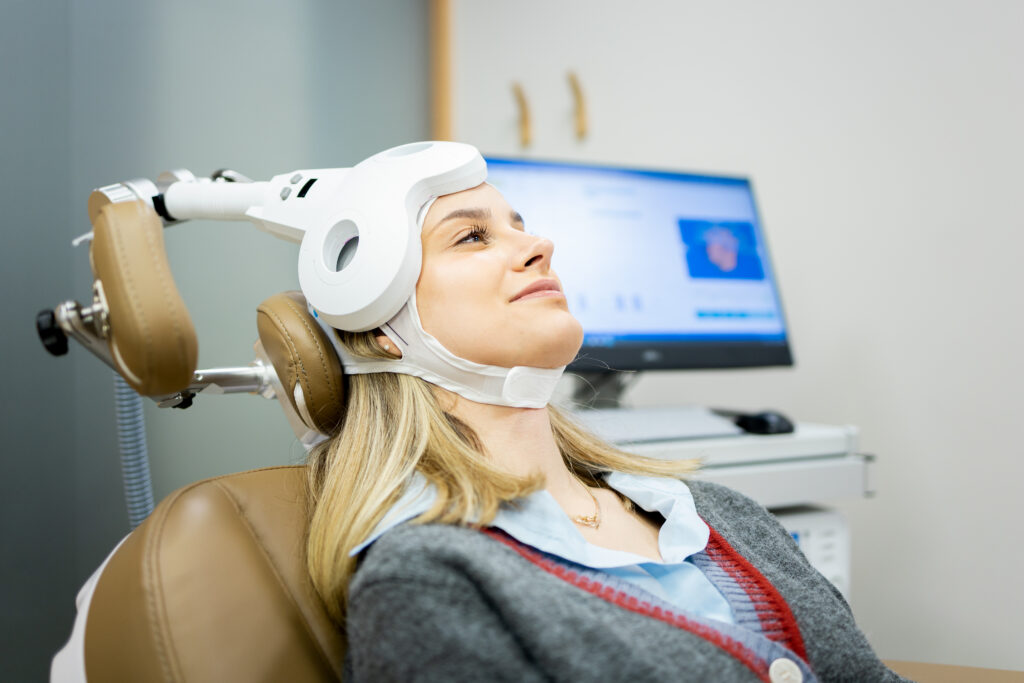
A standard TMS protocol for depression involves daily sessions five days a week for four to six weeks, roughly 30 to 36 sessions in total, with each appointment lasting 20 to 40 minutes. Newer accelerated protocols compress this timeline by delivering multiple sessions per day over a much shorter overall course. NIMH notes that noticeable improvement typically emerges somewhere between weeks two and four of treatment, not immediately, which matters for setting realistic expectations going in. For people who do respond, the effects have been shown to remain durable for a year or longer after treatment ends, which is a meaningfully different pattern than medication, which generally requires ongoing use to maintain its effect.
Side Effects Are Real But Generally Mild
TMS’s most common side effect is discomfort at the treatment site or a mild headache, and Cleveland Clinic reports that most people don’t experience side effects at all, with anything that does occur usually mild and short-lived. Seizure is the most serious possible side effect, but it’s rare, and screening for seizure risk factors, including a personal history of epilepsy or certain metal implants near the head, is a standard part of intake before treatment begins. This is a meaningfully different side-effect profile than most psychiatric medications, which is a large part of TMS’s appeal for people who haven’t tolerated medication well, who’ve dealt with weight gain, sexual side effects, or emotional blunting from prior prescriptions, or who are simply wary of adding another pill to an existing regimen that hasn’t fully worked.
Why TMS Works Best as Part of a Broader Plan
TMS is not typically positioned as a replacement for therapy, and it isn’t at South Orange County Wellness either. It’s most effective when it’s paired with the underlying clinical work — individual therapy addressing the thought patterns and behaviors connected to depression or OCD, and psychiatric oversight to manage medication alongside it, rather than instead of it. Someone with treatment-resistant depression who adds TMS but changes nothing else about their therapy or daily patterns is less likely to see the same gains as someone using TMS as one piece of a coordinated plan. That’s the reasoning behind offering it within structured treatment programs — Partial Hospitalization Program, Intensive Outpatient Program, or individual outpatient care — rather than as an isolated procedure disconnected from everything else happening in someone’s treatment.
Who TMS Tends to Be a Good Fit For
TMS is generally considered for people who’ve tried at least one, and often several, antidepressant medications without adequate relief, or for people with OCD whose symptoms haven’t responded to standard exposure and response prevention and medication combined. It’s not typically a first-line treatment before other options have been tried, in part because insurance coverage criteria usually require documentation of prior treatment attempts, and in part because medication and therapy remain effective first steps for many people. For those who’ve genuinely reached that point of treatment resistance, though, TMS offers a legitimate, well-studied option that doesn’t carry the systemic side effects associated with many medications, and it’s increasingly viewed as a standard next step rather than a last resort once earlier treatments have clearly stopped working.
Frequently Asked Questions
Does TMS hurt? Most people describe a tapping or knocking sensation at the treatment site rather than pain, though some experience mild discomfort or a headache, particularly during the first few sessions.
How is TMS different from electroconvulsive therapy (ECT)? TMS doesn’t require anesthesia, sedation, or induce a seizure, and there’s no recovery time needed afterward. ECT is generally reserved for more severe or urgent cases and involves a different mechanism and risk profile entirely.
How long do the effects of TMS last? For people who respond, benefits have been shown to remain durable for a year or more after a completed course, though outcomes vary and some people benefit from maintenance sessions.
Is TMS covered by insurance? Many insurance plans cover TMS for treatment-resistant depression when specific criteria are met, typically including documented lack of response to prior medication trials; coverage for OCD and other uses varies more by plan.
If medication alone hasn’t gotten you where you need to be, TMS is worth a real conversation rather than dismissal. Call South Orange County Wellness at (949) 736-4494 to find out whether it could be part of your treatment plan.